J. Normand Martin


Expo '67 Models
From "Maine Line", Bangor and Aroostook Railroad, August-September 1967;
- Railroaders who visit the Maine Pavilion at Expo 67 in Montreal, Canada are universally delighted to find a care-fully-scaled model of a Bangor and Aroostook freight winding in and out of the pavilion through openings in the west wall. Railroaders aren't the only spectators who are fascinated by the colorful, 55-foot long train, though. It attracts small fry and parents alike and officials at the Maine pavilion credit the train as a top drawing card for the exhibits inside.
- A year-and-a-half ago the idea of a model train was just a gleam in the eye of Clarence McKay, deputy commissioner of the Pavilion. The Bangor and Aroostook agreed to pick up half of the $18,000 tab and the Department of Economic Development paid the remaining $9,000. J. Normand Martin, president and owner of Tom Kane Advertising, agreed to build the train and track to precise specifications despite bids of up to $50,000 from out-of-state companies.
- The train, built to a scale of an inch to the foot, was a year in the building. During the year Martin spent many hours at the Bangor and Aroostook's Northern Maine Junction Diesel Shop studying drawings and the actual working parts of a full-size diesel. The locomotive he modeled was one of the road's new GP-38, No. 82. Working from photographs and drawings, Martin made his own patterns for casting by Maine firms.
- After several weeks of intensive effort he presented his work at the foundry where a silent and imposing old craftsman examined his work with a critical eye. Minutes ticked by punctuated by an occasional "humph" from the old man while Martin fidgeted. He had never made patterns and if it was wrong there wasn't time to re-do the job.
- After what seems an interminable length of time, he looked up at Martin with some amusement. "That's a damn good job," he said.
- The work went on through the winter and the train began to take shape, from the amazingly detailed cars to the locomotive and track. No detail was overlooked, even the hand brakes on the scaled down cars.
- Roofs were remade because they lacked authenticity. Most of the construction was done in his basement workshop through the winter and spring.
- The finished product was taken to Expo by the deadline. Finished, the train weighs more than half a ton, has 14 cars, locomotive and a caboose, the C-68, modeled after an actual caboose. The diesel is powered by an electric motor that operates on a bank of re-chargable batteries. The train winds its way in and out of the building for 10 hours without recharging. It can be stopped and started by a small toggle switch on the engine.
- The train, the only one at the Expo, seems to bring out the child in most adult of observers, some of whom have watched it for as long as a half an hour. Even in a wonderland like Expo, where the spectacular soon becomes commonplace, the train is fascinating.
- "We've had people try to buy it," says Marshall Rice, Jr., an employee at the exposition, "and many have asked where they could get one like it. We can count on getting a whole battery of questions every day."
- During a day when there's a gate of 250,000 persons, officials estimate that about 40,000 people go through the Maine Pavilion. Many of them have been lured there by the colorful little train emerging through the side of the building. The blue, white and red cars are filled with samples of Maine products.
- As might be expected from so complicated a model, there have been some problems. The initial performance was plagued by periodic hotboxes on the engine and eventual journal failure. "When it first happened," Marshall Rice explained, "We called the CN people in Montreal for help. A couple of their officials came over expecting to find a full-sized diesel. They were so intrigued with the model that they rolled up their sleeves and repaired it on the spot." Later it was discovered that the bearings were wrong and the trouble was corrected. Martin made one trip to Montreal to inspect the train himself.
- The center of the Maine Pavilion features animated manikins in various outdoor sporting settings. Occasionally a youngster will reach through the fence and pluck one of the items from the display car. At other times, debris tossed on the track has derailed the 450-pound locomotive. But it has survived the attempts and continues to be a top drawing card for the State of Maine at Expo 67.
- When Expo closes in the fall, the train will be brought home and will be available for use both by the state and by the railroad. Railroad officials feel that the great exposure afforded by having the model at the fair more than justified the modest investment.
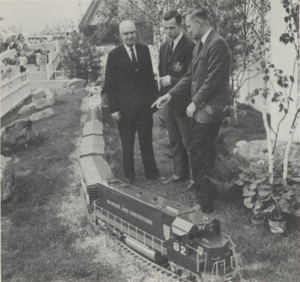
BAR President W. Jerome Strout, Marshall Rice, Jr., a state employee, and Vice President-Operations and Maintenance Palmer H. Swales look over an operating model of a Bangor and Aroostook train at the Maine Pavilion at Expo67.
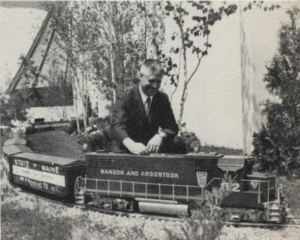
Govenor Kenneth Curtis posed with the model during Maine Day at the Expo.
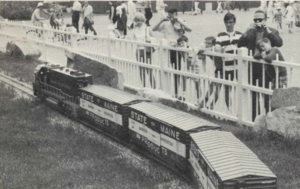
The train, which runs on an oval track both inside and outside the pavilion, attracts both old and young, left, who often climb the fence for a better view.
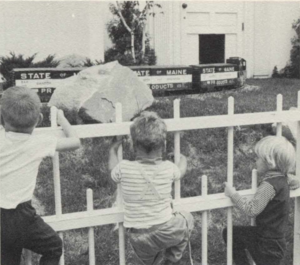
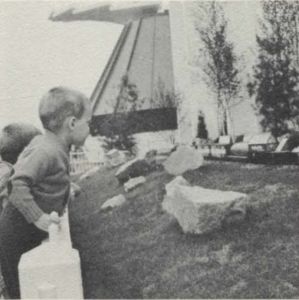
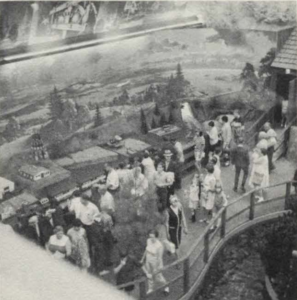
Inside the pavilion the train winds through scaled down Maine landscape. The entire train weighs more than half a ton.
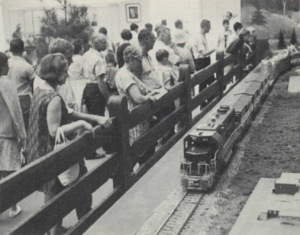
Inside, train pulls Bangor and Aroostook Blue, White and Red cars displaying Maine products, intriguing young visitors, some of whom watch the train for as long as half an hour without moving.
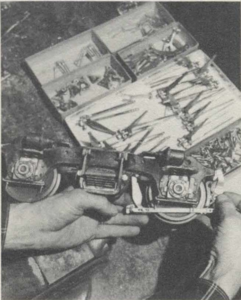
Authenticity is apparent in the fine detail of the truck design.
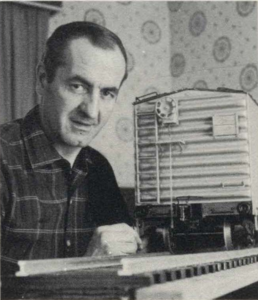
Builder J. Normand Martin demonstrates the fine detail typical of the entire train.
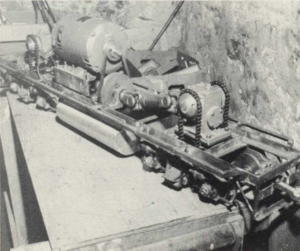
Stripped engine unit shows the detail of the driving mechanism and the reason for the weight (450 pounds) of the locomotive.
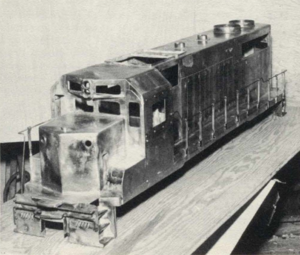
The exterior shell is made of solid brass.


Funding
From John Atkinson:
Here’s an interesting twist in how 1 inch scale model railroad equipment was funded for construction.
From the Obituary link below, it states that in 1966, J. Normand Martin accepted a commission from the State of Maine to design and fabricate a large-scale model of the Bangor and Aroostook Railroad train engine and cars to promote Maine industry at the World’s Fair in Montreal, known as “Expo ’67”. The train ran on track he designed to loop in and outside the Maine Pavilion, and became an enormous attraction for the millions who attended that summer.
From J. Normand Martin obituary, www.tribunearchive.com
- In 1966, he accepted a commission from the State of Maine to design and fabricate a large-scale model of the Bangor and Aroostook Railroad train engine and cars to promote Maine industry at the World’s Fair in Montreal, known as “Expo ’67”. The train ran on track he designed to loop in and outside the Maine Pavilion, and became an enormous attraction for the millions who attended that summer.
The railroad project seems to also serve as an example of someone who built a brand new “present day” locomotive at the same time the real thing was introduced. GP-38 locomotives debuted in 1966.
The attached scan from October 1970 Model Railroader Magazine shows the very interesting locomotive drive train arrangement. Being a “motor man”, I recognize the shunt wound D.C. motor as an open drip proof Reliance in a 56H frame configuration. The open port seen on the side of the motor is for access to the carbon brushes. It’s possibly a 90 volt motor rated at 1/4 HP, but it could also be a 1/6 HP.

Paul Bunyan Statue
From Facebook:
- City of Bangor, Maine - City Hall
- The City of Bangor expresses its condolences to the family of J. Normand Martin who passed away on Friday at the age of 95 years old.
In January, Mr. Martin was formally recognized by the City Council for his contribution to the City of Bangor. More than six decades ago, Martin was commissioned by the City to design the iconic Paul Bunyan statue that stands on Main Street. He was paid $137 to design the 22-inch clay model that took months to create. Martin held that model in his lap all the way to New York City, hopeful that a well-known company, Messmoor & Damon, could replicate it. They did so and donated it to the City of Bangor in 1959- in time for the celebration of the City’s 125th anniversary. The 31-foot high fiberglass-over-metal statue of the legendary lumberjack has been standing guard over the Queen City ever since.
- Thank you, Mr. Martin. You will be fondly remembered.
