Dale VanStee: Difference between revisions
Jump to navigation
Jump to search
| Line 12: | Line 12: | ||
: Finally, in 1969, they decided that there had been enough talk, took the bull by the horns and started on the project. The first construction consisted of a loop behind the house with some sidings and a three-track train storage building. Rail was fastened to ties at one side only and then laid on the graded right-of-way. At that point, the other rail was gauged and fastened in place, with rail joints staggered about five feet. Ties were 2X4s ripped length-ways and then cut into 14 inch lengths. All ties were treated with a 50/50 mixture of creosote and fuel oil. The track was then leveled by raising and sighting until about 2 or 3 inches of 3/8 inch crushed stone ballast was under the ties. All curves are elevated by 1/2 bubble on a level. | : Finally, in 1969, they decided that there had been enough talk, took the bull by the horns and started on the project. The first construction consisted of a loop behind the house with some sidings and a three-track train storage building. Rail was fastened to ties at one side only and then laid on the graded right-of-way. At that point, the other rail was gauged and fastened in place, with rail joints staggered about five feet. Ties were 2X4s ripped length-ways and then cut into 14 inch lengths. All ties were treated with a 50/50 mixture of creosote and fuel oil. The track was then leveled by raising and sighting until about 2 or 3 inches of 3/8 inch crushed stone ballast was under the ties. All curves are elevated by 1/2 bubble on a level. | ||
: But "starting" really began after that, when every evening or week end for a year-and-a-half was spent riding a front loader loaned by a local business to build a fill about twenty feet high, 150 feet long and sixty feet across the base! But, before you get to thinking that was a big job, you must realize that the fill couldn't restrict the natural flow of drainage and three trestles were required - each sixty-five feet long and | : But "starting" really began after that, when every evening or week end for a year-and-a-half was spent riding a front loader loaned by a local business to build a fill about twenty feet high, 150 feet long and sixty feet across the base! But, before you get to thinking that was a big job, you must realize that the fill couldn't restrict the natural flow of drainage and three trestles were required - each sixty-five feet long and twelve feet high! (Anyone want to tell us now about how hard it is to lay track on a flat piece of property?) | ||
twelve feet high! (Anyone want to tell us now about how hard it is to lay track on a flat piece of property?) | |||
The trestles are all built of 4X4s, creosoted, cross-braced and set on concrete footings five feet on centers. Decking is 2X4s X 42 | : The trestles are all built of 4X4s, creosoted, cross-braced and set on concrete footings five feet on centers. Decking is 2X4s X 42 inch width - enough room to get your feet out in case of a derailment. Railings are now being installed. Building Trestle #1 took a full summer of work but trains could then run out to Midway Siding. Trestle #2 took nearly another summer's work but the track could then be laid down to the loop at Wood Lot Spur. Trestle #3 was the final link and the track, as it now stands, was complete. | ||
: Traffic is usually operated in a pattern that takes best advantage of the grades involved. Starting at the Station Area, your train swings around a curve, past the yards and engine house and down a 6% grade. You stop on Trestle #3 for the red signal. Off to your left is Trestle #1 and, looking down and through the bents, you see a loop of track twenty feet below! You press a signal button and, if there are no approaching trains between you and Midway Siding, the signal turns to "clear" and you proceed down a 1.5% grade across the Big Fill to Midway Siding. Opposing trains are directed to proper tracks by spring switches so no stops are necessary if there are no opposing trains. | |||
: From Midway Siding, you head across Trestle #2, around another curve and down the grade which increases to 6% for the last few feet. At the loop, you can look up at trains twenty feet above and watch them make their way along the track. | |||
: Low point is at the loop near Wood Lot Spur where the return trip starts up a 1.5% grade back up to Midway Siding. Again you stop at the signal, press the button and, if the signal shows "clear" you head out onto the main line and up the 1.5% grade, across Trestle #1 on a 4% grade and continue up and around the curve back to the Station Area. | : Low point is at the loop near Wood Lot Spur where the return trip starts up a 1.5% grade back up to Midway Siding. Again you stop at the signal, press the button and, if the signal shows "clear" you head out onto the main line and up the 1.5% grade, across Trestle #1 on a 4% grade and continue up and around the curve back to the Station Area. | ||
Revision as of 16:41, 15 January 2026
Dale VanStee was a member of the Tri-State Locomotive Club, serving as its president for over 30 years. He built and operated the Very Slow & Hazardous Railroad on the property behind his home in Grand Rapids.
Very Slow & Hazardous Railroad
- Spectacular scenary abounds on the Very Slow & Hazardous
- by William C. Fitt
- From Modeltec, June 1984
- You would never believe it... driving down a busy four-lane street in Grand Rapids ... but behind a row of houses lies one of the most spectacular 7-1/2 inch gauge railroads to be found anywhere! And it's a safe bet that, if most of us had seen the site a few years ago, about 99.44% of us would have walked right past and not even given thought to building a railroad in the hollow that laid there since the glaciers retreated over this land ten thousand years or more ago. Not so with Dale VanStee. When Dale moved there with his wife, Thelma, in 1950, it was "way out in the country and away from all the hustle and bustle of city life." The clay road would assure seclusion and "no one else will know we're around!" Yep!!! Dale studied that hollow and looked it over time after time. Little by little, the possibilities for a 7-1/2 inch gauge railroad began to take shape in his mind's eye and he discussed them with his close friend, Serge Hafer. They talked it over at every chance they had.
- Finally, in 1969, they decided that there had been enough talk, took the bull by the horns and started on the project. The first construction consisted of a loop behind the house with some sidings and a three-track train storage building. Rail was fastened to ties at one side only and then laid on the graded right-of-way. At that point, the other rail was gauged and fastened in place, with rail joints staggered about five feet. Ties were 2X4s ripped length-ways and then cut into 14 inch lengths. All ties were treated with a 50/50 mixture of creosote and fuel oil. The track was then leveled by raising and sighting until about 2 or 3 inches of 3/8 inch crushed stone ballast was under the ties. All curves are elevated by 1/2 bubble on a level.
- But "starting" really began after that, when every evening or week end for a year-and-a-half was spent riding a front loader loaned by a local business to build a fill about twenty feet high, 150 feet long and sixty feet across the base! But, before you get to thinking that was a big job, you must realize that the fill couldn't restrict the natural flow of drainage and three trestles were required - each sixty-five feet long and twelve feet high! (Anyone want to tell us now about how hard it is to lay track on a flat piece of property?)
- The trestles are all built of 4X4s, creosoted, cross-braced and set on concrete footings five feet on centers. Decking is 2X4s X 42 inch width - enough room to get your feet out in case of a derailment. Railings are now being installed. Building Trestle #1 took a full summer of work but trains could then run out to Midway Siding. Trestle #2 took nearly another summer's work but the track could then be laid down to the loop at Wood Lot Spur. Trestle #3 was the final link and the track, as it now stands, was complete.
- Traffic is usually operated in a pattern that takes best advantage of the grades involved. Starting at the Station Area, your train swings around a curve, past the yards and engine house and down a 6% grade. You stop on Trestle #3 for the red signal. Off to your left is Trestle #1 and, looking down and through the bents, you see a loop of track twenty feet below! You press a signal button and, if there are no approaching trains between you and Midway Siding, the signal turns to "clear" and you proceed down a 1.5% grade across the Big Fill to Midway Siding. Opposing trains are directed to proper tracks by spring switches so no stops are necessary if there are no opposing trains.
- From Midway Siding, you head across Trestle #2, around another curve and down the grade which increases to 6% for the last few feet. At the loop, you can look up at trains twenty feet above and watch them make their way along the track.
- Low point is at the loop near Wood Lot Spur where the return trip starts up a 1.5% grade back up to Midway Siding. Again you stop at the signal, press the button and, if the signal shows "clear" you head out onto the main line and up the 1.5% grade, across Trestle #1 on a 4% grade and continue up and around the curve back to the Station Area.
- Quite a trip!
- You have been so impressed by the system that you failed to notice at first that the property is now almost entirely surrounded by homes built in a subdivision bordering Dale's property. Fortunately, there is even a natural berm that screens the Station Area from the heavy traffic that now passes in front on the busy road. For the past five years, the Tri-State Locomotive Club has hosted a winter meet. The first four were held in Kalamazoo, two on Harry Herder's track and two at Tom Briggs' track. In 1984, the meet was hosted by Dale and Serge on the VS&H which, you have probably guessed by now, stands for VanStee & Hafer and not Very Slow & Hazardous. The invitation always includes a reminder to bring snow shovels and winter clothing because the snow can get very deep and weather very "iffy" during February in Michigan.
- This year, however, was quite a change with almost shirt-sleeve weather and little or no snow left on the ground from a mild winter season. VS&H motive power consists of a Gallopin' Goose, two Baldwin RS-2 diesels, a Plymouth 3-axle unit (another is under construction with plans to M.U.) and 9 riding cars. Under construction, too, are a Live Steam 4-4-0 and a 4-8-2!
- There isn't much room left for big expansion of the track but Dale and Serge are considering extension of Midway Siding back towards the Big Fill and the addition of some more sidings down at Wood Lot Spur.
- With a challenging system such as they have operating now, it might seem to an "outsider" that they would be content to just ride their equipment every chance they had. As it seems, though, that is not the usual make-up of Live Steamers.
- Of this, though, we are sure: this will not be the last report about activity on the Very Slow & Hazardous Railroad!
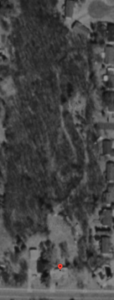
Satellite view of the Very Slow & Hazardous Railroad, March 27, 1999. From Google Earth.
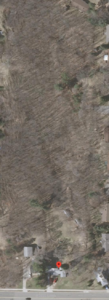
May 30, 2009
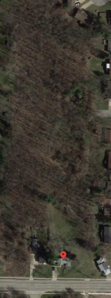
April 15, 2016


Obituary
From Dignity Memorial
- Dale Frank VanStee
- January 28, 1931 – October 28, 2013
- VANSTEE, DALE FRANK Dale VanStee, passed away unexpectedly at his home surrounded by family on Monday October 28, 2013. Dale was preceded in death by his parents Martin and Evelyn VanStee, his mother and father-i n-law, Horace and Mildred Proper, along with his brother Leroy VanStee; brother and sister in-laws: Orson Grant, Leora and Bill Utting, Monte and Louise Proper, Theodore and Viola Proper, Dale Proper, Ruth and Ike Dodd. Surviving is his loving wife of 64 years Thelma, children: Glenn (Linda), Roger (Kathy), Douglas, Kathy, Craig (Nancy Tanis) and Jeffery (Lisa); Also, his brother James (Joyce) and sister-in-law Patricia Proper, 30 grandchildren, 42 great grandchildren and seven great great grandchildren, along with many nieces and nephews. Dale had several hobbies, the number one was Trains. Whether it was the one he had running around the basement or the one around the back yard, he loved them both. Dale was a member of the Tri-State Locomotive Club, serving as its president for over 30 years. Dale was also very involved with the boy scouts and the explorers, taking several trips with them up into the wilderness of Canada. He loved music, notably Jazz from the 30's and 40's, and you could also catch him listening to the classics as well. Another of his hobbies besides the family, was to travel, which he and Thelma did several times a year. Dale proudly served his country in the Michigan Army National Guard from 1946 - 1950 and will be sadly missed by everyone who knew him. Please join his family for visitation on Thursday, October 31, 2013 from both 2-4 and 6-8 pm at Reyers North Valley Chapel. Funeral Services will be held at 2 pm on Friday, November 1, 2013, also at the funeral home with one hour additional visitation from 1-2 pm. Interment in Blythefield Memory Gardens.